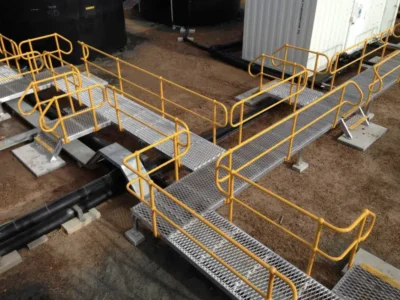
Marine sites generate wastewater unlike any other industrial stream. A marine wastewater treatment system has to handle copper and zinc from antifouling paint, oils, surfactants and blast residue in the same drain, and slipway runoff sweeps that load into stormwater that arrives in unpredictable peaks. Bilge water and vessel sewage add their own complications on top.
Why Marina and Shipyard Wash Water is Hard To Treat
The hard part is the way contaminants arrive together. Copper and zinc leach from antifouling paint during the hull cleaning process and are quite stubborn to remove in suspension. Surfactants in hull soap emulsify the oil that would otherwise float clear in a separator. Blast residue adds sediment, and older vessels can still drop residual tributyltin that persists in dock-floor sediment for decades.
Flow is the other problem. Marina hardstands and slipways are stormwater-driven, so the load arrives in pulses tied to weather and tide. The first 10mm of rain off a hardstand carries the bulk of the day’s pollutants. Miss that first flush and the rest of the catchment runs to the harbour. Biological treatment, the workhorse for food and dairy sites, doesn’t survive a heavy metal load, so most marine sites need a physical-chemical train.
How a Marine Wastewater System Works
First in line is a first-flush diversion and buffer tank. They handle flow, not contaminants, catching the initial heavy-load slug from a rainfall event and giving the rest of the plant a steady feed rate. Without that buffer, the downstream chemistry can’t keep up.
| Stage | What it handles | Why it Sits Here |
|---|---|---|
| 1. First-flush diversion + buffer tank | Initial heavy-load slug from rainfall; smooths flow into the rest of the plant | Stormwater pulses crush downstream chemistry without it |
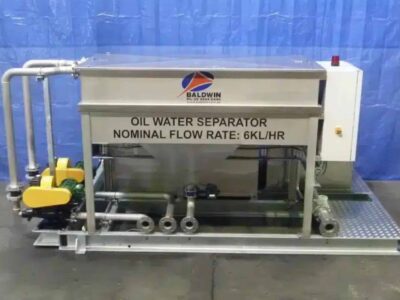
| 2. Coalescing plate oil-water separator | Free oils and gross sediment | Physical settling is cheap and removes the bulk solids before any reagent cost |
| 3. Chemical coagulation | Destabilises dissolved metals and the colloidal mix | Antifouling copper and zinc won’t settle out on their own |
| 4. Flocculation | Builds micro-flocs into particles large enough to float | Gives the DAF cell something to lift |
| 5. Dissolved air flotation (DAF) | Emulsified oils, surfactant-bound oils, heavy metals (copper, zinc), suspended solids | Trade waste limits for metals can’t be met without it |
| 6. pH dosing | Adjusts pH into the consent window (usually 6 to 10) | Discharge fails the consent if pH drifts outside |
| 7. Polishing filtration | Residual fines, plus dissolved hydrocarbons, where activated carbon is added | Final guard before sewer connection or on-site reuse |
| 8. Sludge thickening and dewatering | Water content in DAF sludge | Disposal costs scale with weight, so on-site dewatering keeps them down |
Marine Wastewater Rules & Compliance in Australia
Marine sites sit under more regulators than almost any other industrial use of water. International conventions, federal pollution rules, state EPA frameworks and the local water utility’s trade waste team can all enforce against the same discharge point.
International and federal
- MARPOL Annex I sets the bilge water bar at 15 ppm of oil in discharge and requires approved oil filtering equipment on vessels above 400 gross tonnes.
- MARPOL Annex IV covers vessel sewage.
- AMSA enforces both through Marine Order 96, with untreated sewage discharge generally restricted to beyond 12 nautical miles from the coast.
- Stricter rules apply inside the Great Barrier Reef Marine Park, Torres Strait, enclosed waters, and within one nautical mile of aquaculture leases.
State frameworks
- South Australia: Code of Practice for Vessel and Facility Management, with mandatory accredited inspections of commercial vessel wastewater infrastructure every five years.
- New South Wales: Marine Pollution Regulation 2024.
- Queensland: Maritime Safety Queensland treats every boat harbour, canal and marina as prohibited discharge waters for sewage.
- Western Australia: Water Services Act 2012 plus state EPA policy.
Trade waste consent
- Sydney Water, Hunter Water, SA Water, Water Corporation and Yarra Valley Water all classify treated hardstand discharge as trade waste.
- Limits apply to pH, oil and grease, suspended solids and the heavy metal suite.
- Fees are volume and load-based, which turns a poorly run system into a recurring cost line.
The audit finding that comes up most often on marine sites is missing first-flush capture from hardstand or slipway surfaces, picked up against state EPA stormwater rules.
How Baldwin Helps Marine Operators
A useful marine treatment design starts before any equipment is specified. Site assessment captures actual flows under both production and storm conditions, the existing drainage layout, the contaminant fingerprint from the hull cleaning chemistry on site, and the footprint constraints the new train has to fit. On a brownfield marina or shipyard, available space drives the design more than treatment chemistry does.
Design and fabrication happen in-house at the Australian factory under ISO 9001. Plate separators, DAF cells, clarifiers and pH dosing units come off the same shop floor. Custom fabrication in marine-grade aluminium, stainless steel and ABS plastic handles the salt exposure that destroys mild steel quickly. The full train ships and installs as one job.
Once commissioned, operators usually need help with two things: trade waste reporting and sludge management. A service relationship with the original manufacturer means the technician on site already knows the dosing setpoints, the pump curves and the alarm history. National distributor coverage means response time doesn’t depend on which capital city the plant happens to be near.
Frequently Asked Questions
What does a marina hardstand need to meet trade waste limits?
At a minimum: oil-water separation for free hydrocarbons, chemical coagulation with DAF to drop dissolved copper and zinc, and pH dosing to land inside the consent window. Exact sizing depends on hardstand area, peak storm flow and your water authority’s limits. Talk to Baldwin for a site-specific spec.
How is bilge water treated before it can go to the sewer?
A coalescing plate oil-water separator handles most of the load to meet the MARPOL 15 ppm threshold, with polishing filtration on the back end. Heavier emulsified loads also need DAF.
Do slipways need first-flush capture even if washdown is occasional?
Yes. Council and state EPA stormwater rules apply to the surface itself, not to washdown events. The first 10mm of rain off blast residue and paint flake carries more pollutant load than most washdown cycles.
Can one system treat hardstand washdown and vessel sewage on the same site?
Usually not in the same tank. A single treatment building can run a packaged biological plant for sewage alongside a physical-chemical train for hardstand washdown, both reporting against the same trade waste consent.
What's the difference between an oil-water separator and DAF for marine sites?
A coalescing plate separator catches free oils and gross sediment by physical settling. DAF uses chemistry and fine bubbles to lift emulsified oils and dissolved metals like copper and zinc that separators can’t touch.
How much sludge does a busy shipyard produce from a DAF system?
Volumes are site-specific, but a high-throughput hardstand can produce hundreds of kilos a week from the DAF and coagulation stages. On-site thickening and dewatering keep disposal costs in check.
Are Australian-made treatment plants preferred for naval and defence work?
Often yes. For Commonwealth-owned and Department of Defence sites, sovereign capability considerations typically favour Australian-designed and Australian-built plants in addition to the usual state EPA conditions.
How long does a marine wastewater system take to design and install?
Most projects move from site assessment to commissioning in three to six months, depending on permits and the level of custom fabrication required. Retrofits on space-constrained sites take longer than greenfield builds. Get in touch to start a site assessment.
Industrial Wastewater Treatment Resources
Wastewater Treatment Technologies
The treatment technologies Baldwin applies by process and application