
Chemical treatment of wastewater uses coagulation, flocculation and chemical precipitation to remove contaminants that physical separation alone cannot reach: dissolved heavy metals, emulsified oils, surfactants and fine suspended solids. In Australia, most industrial sites discharging to sewer or stormwater must chemically treat their wastewater under the terms of their EPA licence or trade waste agreement.
Without effective treatment, your operation risks breaching the concentration limits set by authorities such as Sydney Water (e.g. 5 mg/L for copper and zinc, 2 mg/L for lead), EPA Victoria or the WA Water Corporation. Penalties range from excess-mass surcharges and trade waste consent variations to sewer disconnection, licence suspension and prosecution.
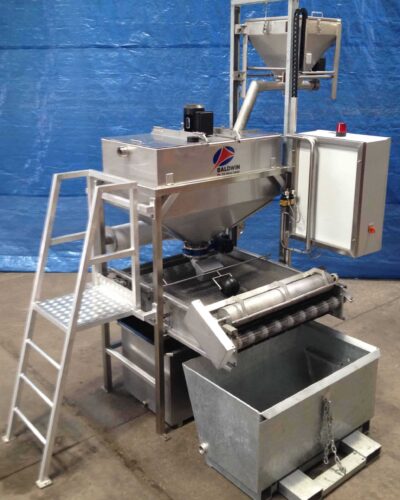
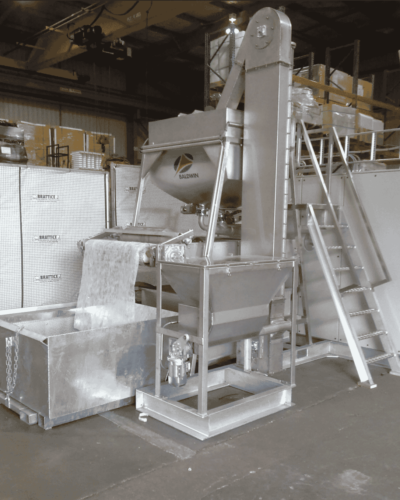
The Baldwin RM-10 handles the full chemical treatment sequence in a single automated unit: dosing, coagulation, flocculation, oil separation and sludge handling. Your site meets its discharge obligations without assembling multiple pieces of standalone equipment.
RM-10 Industrial Chemical Treatment of Wastewater
What Is the Baldwin RM-10 Wastewater Treatment System?
The RM-10 is Baldwin’s industrial chemical treatment and oil separation system, designed for sites that must bring wastewater within the contaminant limits set by their EPA licence or trade waste agreement before discharge to sewer or stormwater.
Using a bentonite-based coagulation process, the RM-10 binds oils, greases, emulsified hydrocarbons, surfactants and dissolved heavy metals (including zinc, copper, lead and chromium) into a dense, dry sludge. Published studies on bentonite coagulation report 88-99% removal of zinc, copper and lead from industrial wastewater when pH is maintained within the optimal hydroxide precipitation range. The sludge separates cleanly from the treated water, leaving an effluent suitable for compliant discharge.
Unlike a standard chemical dosing system, the RM-10 handles the complete treatment sequence in a single automated unit. Chemical dosing, coagulation and flocculation, oil and grease separation, and sludge handling all occur within the one process.
Australian-made and PLC-controlled, the RM-10 is configured by Baldwin’s engineering team based on your site’s wastewater sample analysis, flow rate and the specific discharge limits in your trade waste agreement or EPA licence. Baldwin systems are available for flow rates from 1,000 to 10,000 litres per hour.
Explore Baldwin’s full range of wastewater treatment products to see how the RM-10 fits within a complete industrial effluent treatment system.
How Does The RM-10 Chemical Treatment Process Work?
The RM-10 follows a structured treatment process that takes contaminated industrial wastewater from raw influent to compliant effluent in a single automated pass.
1. Chemical Dosing and Coagulation
Baldwin’s bentonite-based treatment chemicals are dosed into the wastewater stream. The bentonite acts as a coagulant, destabilising dissolved heavy metals, emulsified oils, surfactants and suspended solids so they aggregate into removable particles. Bentonite’s effectiveness comes from its high cation exchange capacity and large surface area, which allow it to adsorb metal ions and neutralise the electrical charges that keep fine contaminants in suspension.
2. pH Adjustment
pH is continuously monitored and adjusted to maintain the optimal range for metal hydroxide precipitation, typically between pH 8.5 and 10.5 depending on the metals present. Each metal precipitates most effectively at a different pH: copper at approximately pH 8.0-9.5, zinc at pH 8.5-10.5, lead at pH 9.0-10.0 and chromium(III) at pH 7.5-8.5. Because zinc and lead hydroxides are amphoteric (they redissolve if pH rises too high), precise PLC-controlled adjustment is critical in mixed-metal wastewater. Baldwin’s pH control and chemical dosing systems manage this automatically based on real-time sensor feedback.
3. Flocculation and Chemical Precipitation
Bound particles aggregate into larger flocs through controlled flocculation. Dissolved contaminants precipitate out of solution as stable solids: metal hydroxides, insoluble oil-bentonite complexes and bound suspended matter. The process reduces contaminant concentrations to within the limits set by your trade waste agreement. For context, Sydney Water’s industrial acceptance standards require copper and zinc below 5 mg/L, lead below 2 mg/L, and petroleum hydrocarbons below 10 mg/L. Melbourne’s metro water retailers set zinc even tighter at 1 mg/L.
4. Integrated Oil and Grease Separation
Free and emulsified oils are removed during the coagulation and flocculation stages without a separate oil-water separator. This is critical because gravity-based separators and coalescing plate units are only effective on oil droplets above approximately 20 microns. Below that threshold, Stokes’ Law means droplet rise velocity drops so sharply that mechanical separation fails regardless of residence time. The RM-10’s bentonite coagulation process captures these sub-20-micron emulsified hydrocarbons chemically, reaching contaminant fractions that physical separation cannot.
5. Sludge Formation and Handling
The process produces a dense, dry sludge that does not require secondary dewatering equipment such as a separate clarifier or filter press.
6. Automated Operation
The PLC manages chemical dosing, pH monitoring and process sequencing continuously via Baldwin’s integrated control panel architecture.
What Industries Need Wastewater Chemical Treatment?
The RM-10 is used across a broad range of Australian industries where wastewater must meet strict EPA licence or trade waste agreement discharge standards.


The RM-10 is configured to your site’s specific wastewater composition and the contaminant limits set by your trade waste agreement or EPA licence. Baldwin’s engineers review your discharge obligations and wastewater sample results before specifying the system, so the treatment process targets the contaminants your site actually generates.
Risks of Non-Compliant Chemical Treatment of Wastewater
Physical separation alone is not enough for most industrial wastewater. Australian trade waste agreements and EPA licences set contaminant limits that simple settling or oil separation cannot consistently achieve. Sites that generate wastewater containing emulsified oils, dissolved heavy metals or high suspended solids loads are usually required to apply chemical pre-treatment before discharge.
Your specific site obligations are set out by your state water authority or state EPA:
- NSW: Sydney Water’s industrial acceptance standards (document SW79, updated annually) set specific concentration limits as conditions of your trade waste consent. Key limits for RM-10-relevant contaminants include copper 5 mg/L, zinc 5 mg/L, lead 2 mg/L, chromium 3 mg/L, petroleum hydrocarbons 10 mg/L and pH 7-10. Chemical pre-treatment is required where physical separation alone cannot consistently meet these limits. Three notable breaches within six months triggers a consent variation, and Sydney Water’s risk index system means repeated non-compliance directly increases your quarterly management fees, inspection frequency and sampling obligations.
- VIC: The Environment Protection Act 2017 imposes a General Environmental Duty (GED) under section 25, requiring industrial sites to minimise risks of harm to human health and the environment so far as reasonably practicable. Aggravated corporate breaches carry penalties up to $3.3 million. Trade waste discharge is managed through consent agreements with the relevant metropolitan water retailer: Yarra Valley Water (north/east Melbourne), South East Water (south-east) or Greater Western Water (west). Acceptance criteria are harmonised across the three retailers because they share Melbourne Water’s treatment plants. Melbourne metro zinc limits are notably tighter than Sydney at 1 mg/L, with copper at 5 mg/L and lead at 1 mg/L.
- QLD: Queensland runs a two-tier framework. Discharge to the environment requires an Environmental Authority under the Environmental Protection Act 1994 if the activity is a prescribed Environmentally Relevant Activity. Discharge to sewer is governed separately under the Water Supply (Safety and Reliability) Act 2008, with trade waste approvals issued by service providers such as Queensland Urban Utilities (Brisbane/Ipswich), Unitywater (Moreton Bay/Sunshine Coast) and regional councils. QUU’s acceptance limits are notably more permissive than Sydney Water for metals (copper, zinc and lead at 10 mg/L each) but still enforced, with mass loading multipliers applied at smaller treatment plants.
- WA: The WA Water Corporation’s acceptance criteria operate on a mass-threshold model under the Water Services Act 2012: concentration limits for metals only apply once your daily discharge mass exceeds a specified threshold (e.g. 30 g/day for copper or lead, 50 g/day for zinc). Above those thresholds, concentration limits are set at copper 5 mg/L, zinc 3 mg/L, lead 1 mg/L and chromium 3 mg/L. The Water Corporation assesses each site individually as part of the trade waste permit application, with separate pathways for automotive, food preparation and large/complex industrial dischargers.
- SA: SA Water operates under the Water Industry Act 2012 (SA) with environmental backstop from the Environment Protection Act 1993 (SA). Acceptance standards are set in the Restricted Wastewater Acceptance Standards (current framework v1.1, 2022). SA Water’s metal limits are more permissive than eastern states (copper, zinc and lead at 10 mg/L each, chromium at 20 mg/L), but each customer is assigned a risk index that drives inspection frequency and fees. Volume and load-based charges apply above 10 tonnes per year of BOD or suspended solids.
Non-compliance can result in surcharges, sewer disconnection or licence suspension. The RM-10’s chemical dosing, coagulation and flocculation process is specifically designed to bring oils, heavy metals and suspended solids within the limits your approval requires.
Regulations can vary state by state and are updated periodically. You should confirm your site’s specific requirements directly with your state authority or water utility.
Why Australian Industry Chooses Baldwin Industrial Systems
Australian-designed and manufactured
Custom-configured to your site
End-to-end project management
EPA and trade waste compliance experience
Ready to Order an RM-10 Treatment System?
Contact Baldwin’s engineering team on (02) 4954 0440 to discuss your site requirements and receive a quote. Every RM-10 is designed, fabricated and commissioned by Baldwin in Western Sydney, with national service and parts support. Explore Baldwin’s full range of wastewater treatment products to see how the RM-10 fits within a complete treatment system.
Reviewed by Baldwin Industrial Systems’ engineering team
Frequently Asked Questions
What is the chemical treatment of wastewater?
Chemical treatment of wastewater uses coagulation, flocculation and chemical precipitation to remove contaminants that physical separation cannot reach. The process destabilises dissolved metals, emulsified oils, greases and suspended solids, binding them into a stable sludge that separates from the treated water. It is required across manufacturing, mining, food processing and industrial wash bay operations where wastewater must meet the concentration limits set by EPA licences and trade waste agreements. In Australia, those limits are set by state water authorities such as Sydney Water, EPA Victoria’s General Environmental Duty framework, the WA Water Corporation and Queensland Urban Utilities. For a detailed overview, read our complete guide to the chemical treatment of wastewater.
When is chemical treatment required for industrial discharge?
Chemical treatment is required when your wastewater contains contaminants that physical separation alone cannot reduce to within the limits set by your EPA licence or trade waste agreement. The critical threshold is emulsified oil below approximately 20 microns and dissolved metals in solution: gravity-based separators and coalescing plate units cannot remove these contaminants regardless of residence time. This typically applies to wash bays, metal processing, compressor operations, paint application and food manufacturing. Your state water authority or EPA regulator sets the specific discharge limits your site must meet. Not sure what applies to your site? Arrange a site assessment, and a Baldwin engineer will walk you through your obligations.
What contaminants does chemical treatment remove?
The RM-10’s bentonite-based coagulation and flocculation process removes oils and greases, emulsified hydrocarbons (including sub-20-micron droplets that pass through mechanical separators), dissolved heavy metals (zinc, copper, lead, chromium), suspended solids and surfactants. Published studies on bentonite coagulation report removal efficiencies of 88-99% for zinc, copper and lead when pH is held in the optimal precipitation range. Treated effluent is designed to meet the concentration limits in your trade waste agreement, such as Sydney Water’s acceptance standards of 5 mg/L for copper and zinc, 2 mg/L for lead and 10 mg/L for petroleum hydrocarbons.
How does the RM-10 compare to a standard chemical dosing system?
A standard chemical dosing system adds reagents to wastewater but requires separate settling tanks, oil separators and sludge handling equipment: typically three to four additional units that must be individually sized, plumbed and maintained. The RM-10 integrates chemical dosing, coagulation and flocculation, oil and grease separation and sludge formation into a single PLC-controlled unit. This reduces the physical footprint, eliminates the coordination overhead of multiple standalone systems and delivers consistent treatment through automated pH control and flow-proportional dosing.
What is the difference between physical and chemical treatment of wastewater?
Physical treatment uses gravity, screens or coalescing plates to remove solids and free-floating oils. It is effective for particles and oil droplets above approximately 20 microns but cannot remove dissolved metals or emulsified oils below that threshold. Chemical treatment (coagulation, flocculation and precipitation) destabilises those finer contaminants so they can aggregate and be removed as sludge. Most industrial sites need both: a physical separator as the first stage, followed by chemical treatment to bring the remaining contaminants within the concentration limits set by their trade waste agreement.
What is the process of chemical water treatment?
Treatment chemicals (in the RM-10’s case, a bentonite-based coagulant) are dosed into the wastewater to destabilise dissolved and suspended contaminants. The destabilised particles aggregate into larger flocs through flocculation, while dissolved metals precipitate out of solution as insoluble metal hydroxides. pH is adjusted throughout to maintain the optimal precipitation range (typically pH 8.5-10.5 for mixed-metal wastewater). The flocs and precipitates settle as a dense sludge that separates from the treated water. In the RM-10, this entire sequence is automated and PLC-controlled in a single unit.
Is chemical wastewater treatment required under Australian EPA regulations?
Yes, in most cases. Industrial sites discharging wastewater to sewer or stormwater are required to hold a trade waste consent or EPA licence, both of which set mandatory concentration limits for metals, oils, suspended solids and pH. Sites that cannot meet those limits through physical separation alone are required to apply chemical pre-treatment. In NSW, Sydney Water enforces limits under industrial trade waste consents, with three notable breaches in six months triggering a consent variation and escalating through to sewer disconnection and prosecution. In Victoria, EPA Victoria’s General Environmental Duty (section 25, Environment Protection Act 2017) carries aggravated corporate penalties of up to $3.3 million. The WA Water Corporation, SA Water and Queensland service providers such as Queensland Urban Utilities all operate comparable frameworks with site-specific permit conditions and escalating enforcement.
How do I know if I need chemical wastewater treatment?
If your wastewater contains dissolved metals, emulsified oils or fine suspended solids, a physical separator alone will not consistently bring your discharge within the concentration limits set by your trade waste approval. Common indicators include: visible sheen that returns after settling, monitoring results showing metals above acceptance standards (e.g. copper or zinc above 5 mg/L under Sydney Water limits), or a trade waste consent condition requiring chemical pre-treatment. Baldwin’s engineers can attend your site, sample your wastewater and advise on the treatment process your operation requires. Call (02) 4954 0440 to arrange a site assessment.