A food or beverage processing site produces wastewater from every part of its operation, and food and beverage wastewater treatment has to handle all of those streams at once. Production line wash-downs, clean-in-place (CIP) cycles that flush tanks and pipes with caustic and acid, condensate from evaporators and rendering, blood and stickwater from meat plants, fermentation losses from breweries, and bottle and can rinses from soft drink lines. All of it carries fats, soluble sugars, proteins, suspended solids and a pH that can swing from caustic 12 to acidic 2 inside a single shift.
FOG Loading, CIP Swings, and the Trade Waste Bill That Follows
The first is fats, oils and grease, usually shortened to FOG. Animal fats, butter and cream solids, vegetable oils, fryer carryover and pastry shortenings all end up in the drain. Once warm water, detergent and a pump have moved that fat around the site for a few minutes, it is emulsified. The fat is broken up into droplets fine enough that gravity alone will not separate them. Australian abattoir effluent averages around 1,780 milligrams of FOG per litre, and butter-adjacent dairy streams reach 2,880 milligrams per litre. Most water authorities want the discharge under 200 milligrams per litre at the boundary. Urban Utilities in South East Queensland requires it to be under 100 mg/L. The second is the chemical oxygen demand of the dissolved organic load. COD is a lab measurement of how much oxygen would be needed to chemically break down everything dissolved in the water: sugars, alcohol, soluble proteins, organic acids, the lot. Higher COD means a higher organic load, and water authorities surcharge per kilogram of COD discharged above an agreed threshold. Typical raw figures across the sector are wide:
- Red meat abattoirs: 5,000 to 10,000 mg/L, above 50,000 in stickwater and bin drainage
- Dairy: 1,000 to 6,000 mg/L, with whey-bearing streams reaching 80,000
- Wineries during vintage: 10,000 to 50,000 mg/L, with peer-reviewed work recording up to 67,000
- Breweries: 2,000 to 6,000 mg/L combined
- Soft drink: 1,000 to 3,000 mg/L; juice: 2,300 to 11,000 mg/L, depending on product and CIP frequency
The third is variability. CIP cycles flood the drain with hot caustic at pH 12, then acid sanitiser at pH 2 to 4, often inside a single shift. Brew-day transfers, vintage crush peaks, summer soft drink production and dairy plant changeovers all push slug loads through the system that bear no resemblance to a steady daily average. Trade waste agreements police peak hourly concentrations, not just daily averages, which is where most sites get caught out. The sub-sectors where this hits hardest are red meat processing, dairy (especially butter and cheese plants), poultry processing, large commercial bakeries, breweries at commercial scale, and wineries during the vintage window. The chemistry varies. The regulatory consequence is the same: a site that lets raw effluent reach the sewer pays surcharges every day of the year.
Typical raw concentrations by sub-sector
| Sub-sector | Typical raw FOG (mg/L) | Typical raw COD (mg/L) | Notes |
|---|---|---|---|
| Red meat abattoirs | 1,256 to 1,780 average; 7,000+ in stickwater and rendering | 5,000 to 10,000; 50,000+ in stickwater | Blood is the heaviest contributor |
| Dairy (general) | 200 to 400 | 1,000 to 6,000 | Whey loads can reach 80,000 |
| Dairy (butter, cheese) | Up to 2,880 | 2,500 to 8,000+ | FOG and protein dominated |
| Poultry processing | 100 to 2,000 | 2,800 to 5,000 | Skin lipids from scalding |
| Commercial bakery | 100 to 600 (CIP higher) | 1,000 to 3,000 | AU site sampling recommended |
| Breweries | Generally below 100 | 2,000 to 6,000 combined | pH 2 to 12 across the CIP cycle |
| Wineries (vintage) | Low | 10,000 to 50,000+ | Ethanol and VFAs dominate |
| Soft drink | Below 50 | 1,000 to 3,000 | Sugar and acid CIP residues |
| Juice (citrus, apple) | Variable; citrus oil lines higher | 2,300 to 11,000 | Pectin and d-limonene are present |
How a Food and Beverage Treatment Train Is Built Around DAF
A treatment train is the sequence of stages where effluent moves on its way out of the site. Each stage does one job, and the order matters because each stage protects the one downstream. A typical food and beverage train looks like this:
1
Mechanical screening
Coarse solids come out first: bone fragments, paunch material, feathers, dough, vegetable peel, and packaging scraps. Anything that escapes here blinds every downstream unit and chews up pumps. Rotary drum screens suit high-solids streams like abattoirs. Static wedge wire screens handle the lighter solids in dairy and bakery flows.
2
Equalisation
Screened effluent flows into a buffer tank that smooths out the slug loads. Production lines start, finish and clean down at different times, and equalisation gives the downstream stages a steady feed instead of a series of shocks. This is often the highest-value capital spend on the train, dollar for dollar.
3
Acid or caustic is dosed into the equalisation tank or a separate pH correction tank to bring the effluent into a neutral range. This sits before the next stage for a reason. Coagulation chemistry does not work outside a narrow pH band. Any biological treatment further downstream will die at the extremes. Most authorities require discharge between pH 6 and 10. Fixing pH first is what makes everything after it possible.
4
This is the load-bearing stage for primary treatment in food and beverage. A DAF saturates a recycle stream of water with air under pressure (around 400 to 600 kilopascals), then releases it into a flotation cell where the dissolved air comes out of solution as fine micro-bubbles. Those bubbles attach to coagulated fat globules and suspended solids and float them to the surface, where a scraper skims off the float layer. Clarified water leaves the base of the tank.
5
Clarifiers sit alongside or after DAF for steady-state polishing of suspended solids that do not float, particularly at large continuous bottling plants and dairy facilities. Where DAF lifts material up, clarifiers let denser material settle down.
6
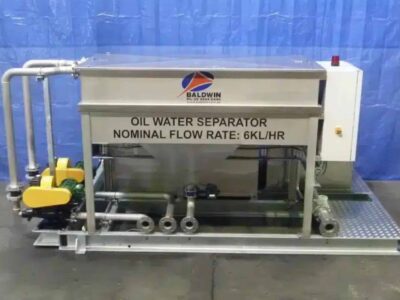
These have a specific role in food and beverage rather than being a primary FOG technology. Coalescing plate separators work well on free, non-emulsified mineral oil, the kind that ends up in drains from packaging machinery, forklift wash bays, boiler condensate and workshop areas. They also have a real role at citrus juice plants, where d-limonene (the essential oil in citrus peel) phase-separates as a free oil. Oil skimmers sit on top of balance and equalisation tanks, pulling off any free oil layer that forms before it can break into an emulsion and burden the DAF.
7
Multimedia, sand or membrane filtration removes the last of the fine solids and chases the COD down further. This stage matters most when treated water is reused on-site (cooling tower top-up, non-food-contact wash-down, irrigation) or when discharge consent limits sit tighter than typical sewer acceptance.
8
Biological treatment, when needed
Sites discharging to municipal sewer usually stop at DAF and filtration. Sites that discharge to a creek, river or ocean outfall need biological treatment downstream to remove the dissolved organic load that primary stages cannot catch. Anaerobic reactors and covered lagoons handle high-strength loads cost-effectively and recover methane biogas. Aerobic systems polish the effluent to discharge quality.

FOG Acceptance Limits Across Australia
| Water authority | FOG acceptance limit | Basis |
|---|---|---|
| Sydney Water (NSW) | Non-discharge prohibition above deemed-domestic equivalent; per-kilogram surcharges apply across BOD, COD, TSS, FOG, N and P | IPART-set 2025-30 pricing determination |
| Yarra Valley Water (VIC) | 200 mg/L emulsified oil, fat or grease | Solvent-extractable, emulsion unstable at 15°C, pH 4.5 to 10 |
| Greater Western Water (VIC) | 200 mg/L emulsified oil and fat | Aligned to the Victorian standard |
| Urban Utilities (QLD) | 100 mg/L total oil and grease | The tightest published numeric limit |
| South East Water (VIC) | Typically 200 mg/L animal and vegetable; 30 mg/L mineral oil | Statement of Approved Acceptance Criteria |
| Water Corporation (WA) | Site-specific acceptance criteria; permit-based | Annual permit, FOGMan charge, quality charges |
Beyond the trade waste agreements, several other named frameworks are required to be complied to on a food and beverage site:
- FSANZ Food Standards Code Standard 3.2.2 (Food Safety Practices and General Requirements), including the obligation to use water of a quality that will not contaminate food.
- FSANZ Food Standards Code Standard 3.2.3 (Food Premises and Equipment), which governs drainage, waste disposal and water supply inside the facility.
- AS/NZS 3500, which governs sanitary plumbing and drainage, including the slope, materials and joint construction of production-area drains.
- Australian Drinking Water Guidelines (NHMRC 2011), which set the quality benchmark for any water in contact with food.
- Australian Guidelines for Water Recycling, which govern any reuse scheme inside the facility.
How Baldwin Sizes, Builds and Supports Treatment Systems for Australian Food and Beverage Sites
Assessment comes first. Before any equipment is specified, the team needs to characterise the effluent stream end to end: flow profile across a production day, peak hourly load during CIP, raw concentration ranges for FOG, COD, TSS, nitrogen and phosphorus, temperature and pH swings, the trade waste limits the site discharges under, and the production growth likely in the next five to ten years. Without that baseline, sizing is guesswork, and the system either underperforms in year one or sits over-spec for a decade. Design and build follow. Treatment train design integrates pH dosing, DAF, clarification, oil-water separation and filtration into a single sequence sized for the actual load, not a stock model with the loose fit that comes from off-the-shelf catalogues. Every Baldwin unit is designed, fabricated and tested in Australia, under ISO 9001 quality management, with 35 years of installed experience to draw on. Custom fabrication is part of the process when standard footprints do not suit the site. Long-term support runs after commissioning. A treatment system is only as good as the operator running it. Servicing, parts supply, chemistry tuning, sludge handling and trade waste compliance reviews are part of the ongoing relationship, delivered through a national distributor network so sites in regional Victoria, NSW, Queensland, WA and SA are not left waiting on a Sydney-based call-out.
Frequently Asked Questions
What is the most commonly used wastewater treatment method in the food and beverage industry?
DAF, which stands for dissolved air flotation. It uses fine air bubbles to lift fats, oils and suspended solids to the surface for skimming, removing more than 95% of FOG in a single stage when the chemistry is dosed correctly. We design and build DAF systems in Australia, sized to your site and your trade waste limits.
How much can trade waste surcharges actually cost a mid-sized food processor each year?
More than most operators realise. Water authorities apply per-kilogram charges on BOD, COD, FOG, suspended solids and nutrients above the agreed limits, and a typical mid-sized site can run into the six figures annually. Get in touch, and we will model your likely exposure based on your effluent profile.
When does a site need biological treatment instead of just primary treatment?
If you discharge to a council sewer, primary pre-treatment (screening, equalisation, pH dosing and DAF) is usually enough. Sites discharging to a creek, river, ocean outfall or other environmental water need biological treatment downstream. Speak to our team about which path fits your site.
Can treated wastewater be reused inside a food processing facility?
Yes, with controls. Non-food-contact uses like cooling tower top-up and wash-down sit under the Australian Guidelines for Water Recycling, while water that touches food has to meet drinking water quality with validated treatment. We can spec the filtration and polishing media that make reuse compliant for your site.
What is the difference between a passive grease arrestor and a dissolved air flotation system?
A grease arrestor is a gravity tank fitted between a commercial kitchen and the sewer, sized for free-floating fat at small volumes. A DAF is an engineered pre-treatment that handles emulsified fat at a manufacturing scale, where a grease arrestor cannot cope. If you are running a dairy plant, abattoir, bakery or beverage line, you need a DAF, and that is what we build.
Industrial Wastewater Treatment Resources
Wastewater Treatment Technologies
The treatment technologies Baldwin applies by process and application