You are here:

Defence bases produce several types of wastewater at the same time: vehicle and aircraft washdown carrying oil, fuel residue and detergents; yard and workshop drainage loaded with brake dust, heavy metals, solvents and coolants; and on bases with a firefighting training history, groundwater contaminated with PFAS chemicals. Each waste stream behaves differently in a treatment plant, so a defence wastewater treatment system usually has to run more than one train at once. That is why most operational bases run several treatment systems side by side.

The Department of Defence owns or operates around 70 major bases and more than 700 properties nationally, with an approved 2024-25 estate capital and sustainment budget of approximately $2.88 billion. Every operational base running vehicle, aircraft or fuel infrastructure has an industrial wastewater obligation that sits across three concurrent compliance layers: the federal Environment Protection and Biodiversity Conservation Act 1999 (EPBC Act), state EPA discharge limits, and trade waste permits from the local water utility.

Vehicle Washdown, Aircraft Runoff, and PFAS-Impacted Water

A large defence base can produce up to 80,000 litres of wash water an hour from armoured vehicle wash bays alone. Aircraft aprons add more on top of that, picking up jet fuel residue and hydraulic fluid as planes are washed and serviced. Firefighting training areas add intermittent runoff that often carries PFAS contamination from foam used years ago.

The oil content in heavy vehicle washdown moves around. It can sit at 50 milligrams per litre at the start of a training day and climb into the thousands by mid-afternoon. Detergents in the wash mix bind oil and water together so tightly that gravity alone will not separate them. That is why coalescing plate oil-water separators are used here instead of a basic gravity tank. Coalescing plates force tiny oil droplets to merge into larger ones that rise to the surface and can be skimmed off. Coalescing plate separators are rated to BS EN 858 Class I performance of 5 mg/L or below under standard test conditions, and typically achieve 5 to 10 mg/L in service, capturing droplets down to 20 to 60 microns and delivering roughly two to three times the throughput of an equivalently sized API gravity separator for the same footprint.

Aircraft hangars and aprons produce less raw oil but more turbine oil and hydraulic fluid. Both of these form very fine droplets in water that a gravity tank cannot remove. Workshop drainage carries copper, zinc, lead, solvents and machining coolant in smaller volumes, but the metals in it need their own treatment chemistry through pH dosing and precipitation.

PFAS (per- and polyfluoroalkyl substances) are long-lasting synthetic chemicals that contaminate water and soil for decades. On defence bases, they mostly come from legacy AFFF firefighting foams used at training areas from the 1970s until Defence began transitioning away from them in 2004. The Defence PFAS Investigation and Management Program covers 28 priority sites under active investigation or remediation, including RAAF Williamtown, Army Aviation Centre Oakey, RAAF Edinburgh, RAAF Tindal and HMAS Albatross Nowra. Class action settlements across these sites have totalled over $345 million. PFAS treatment limits are measured in nanograms per litre (parts per trillion), and the way they are managed is governed by the PFAS National Environmental Management Plan 3.0 (NEMP 3.0), agreed by Australia’s Environment Ministers on 10 December 2024.

Trying to push all these waste streams through a single treatment plant either fails to treat the hardest contaminants properly or wastes capacity on the lightest loads. Defence bases run multiple treatment systems for a reason.

How a Defence Wash Bay Treatment System Is Sequenced

The biggest waste stream on most defence bases is oily washdown water. The treatment system for that stream is built up in stages, and the order matters.

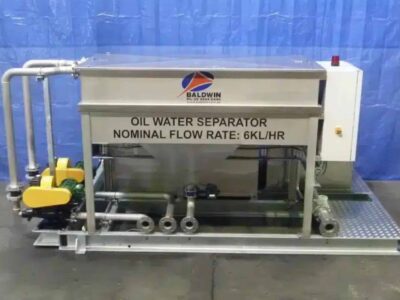
First comes the coalescing plate oil-water separator. It catches free and emulsified oil before anything else, and processes far more flow than a basic gravity tank in the same footprint. When it is sized properly for the actual peak flow on site, it brings the oil concentration in the water down below 10 milligrams per litre. Oil-water separators on defence sites are designed to BS EN 858 Class I performance (5 mg/L or below under standard test conditions) and comply with AS 1940-2017 requirements for interceptors at vehicle refuelling and maintenance areas.

Skipping that first stage wastes treatment chemicals downstream, because the rest of the plant ends up trying to do work the separator should have already done.

After the separator, pH dosing is added. The pH is adjusted into the right range to make dissolved metals (from brake dust, vehicle paint and electroplated parts) drop out of solution as solid particles through hydroxide precipitation.

A dissolved air flotation unit, usually called a DAF, comes next. The DAF dissolves tiny air bubbles into the water. Those bubbles attach to the metal particles and any remaining oil and float them to the surface to be skimmed off. A DAF is used here because those particles are light and oily, which is exactly what defeats a standard settling tank. With chemical pretreatment, DAF systems in washdown applications typically achieve 90 to 99% removal of oil and grease, 85 to 98% TSS removal, and 90 to 99% heavy metal removal. A properly designed DAF also restarts cleanly after a quiet period, which matters on bases where training runs hard for a fortnight then goes idle. The sludge skimmed off the top of the DAF unit is usually 3 to 6 per cent solids and is classified as prescribed waste under most state EPAs because of the oil and grease in it.

After the DAF, multimedia filtration polishes the water. It uses layered beds of sand, gravel and other media to catch the last of the fine particles. This stage is essential where PFAS-contaminated water is also treated through specialised filters downstream. Without it, the PFAS filters clog with carried-over solids within months and have to be replaced at significant cost.

On bases that need PFAS treatment, the specialised filters (granular activated carbon or ion exchange) sit at the very end of the train. Because the upstream stages have already removed most of the contaminants, these final filters last far longer than they would on raw feed. Ion exchange resins designed specifically for PFAS can reduce concentrations from 20,000 ng/L to non-detect at greater than 99.99% removal. Where the PFAS concentration is very high but the volume is low, such as old firefighting foam concentrate or used filter regeneration fluid, foam fractionation is often used instead. Australian-developed foam fractionation systems such as EPOC Enviro’s SAFF technology can achieve greater than 99.9999% removal for long-chain PFAS in 2 to 3 minutes, producing a hyper-concentrate of just 0.025 to 0.25% of the original volume.

Close up of Australian flag on military camouflage uniform.

PFAS on Defence Land

PFAS contamination on defence sites is not a peripheral issue. It is the single largest environmental liability the Department of Defence manages. The Defence PFAS Investigation and Management Program has completed detailed environmental investigations at all 28 priority sites, spanning every state and the Jervis Bay Territory. Publicly named sites include RAAF Williamtown, Army Aviation Centre Oakey, RAAF Edinburgh, RAAF Tindal, HMAS Albatross, RAAF Amberley, RAAF Pearce, RAAF Richmond, Holsworthy Barracks and Lavarack Barracks, among others.

The binding national framework for PFAS management is PFAS NEMP 3.0, agreed by Australia’s Environment Ministers on 10 December 2024 and published by DCCEEW on 4 March 2025. NEMP 3.0 covers six themes: the PFAS chemical family and grouping approaches, environmental data and monitoring, water, soil, resource recovery and waste management, and site-specific application of guidance. It introduces first-time biosolids criteria, tightened ecological soil guideline values, and updated construction-water guidance relevant to any earthworks on PFAS-impacted Defence land.

Current Australian drinking water guideline values for PFAS (updated June 2025 by NHMRC) are PFOS 8 ng/L, PFOA 200 ng/L, PFHxS 30 ng/L and PFBS 1,000 ng/L. These replace the older combined PFOS+PFHxS value of 70 ng/L that is still widely cited in industry material. Recreational water values remain at 2 ug/L (PFOS+PFHxS) and 10 ug/L (PFOA).

NEMP 3.0 is policy guidance, not statutory law. Unlike a National Environment Protection Measure, it has no automatic statutory effect. States implement it through their own EPA licensing and contaminated-land frameworks. The National Environment Protection (Assessment of Site Contamination) Measure 1999 (ASC NEPM), amended 2013, provides the framework for contaminated site investigation and assessment, with NEMP PFAS values overlaid. The Defence PFAS Construction and Maintenance Framework mandates compliance with both NEPM and NEMP for any contractor undertaking earthworks or construction on PFAS-impacted Defence land.

Baldwin designs and builds the upstream treatment infrastructure that conditions water before it reaches PFAS-specific media: oil-water separation, DAF, multimedia filtration and pH dosing. Without effective upstream conditioning, downstream GAC or ion exchange beds clog with floc carryover and require uneconomic replacement intervals.

Trade Waste and EPA Rules Still Apply on Defence Sites

Defence sites sit on Commonwealth land and fall under the federal EPBC Act 1999. That covers project approvals and reporting where the work could affect nationally significant environmental values. But sitting on federal land does not let a defence base ignore state EPA discharge limits or skip the trade waste permit it needs from the local water utility.

The EPBC Act binds the Commonwealth under Section 528, but it operates concurrently with state environmental legislation rather than overriding it. In practice, state EPAs generally lack direct enforcement reach on Commonwealth defence land because state environmental statutes bind their respective state Crown, not the Commonwealth. Enforcement against Defence for environmental breaches flows through Federal Court civil action under EPBC section 475, inter-governmental administrative processes, or Ministerial referral. However, trade waste agreements with state-owned water utilities (Sydney Water, Hunter Water, Yarra Valley Water, Unitywater or Water Corporation, depending on location) operate as commercial contracts under state water industry legislation. Defence enters them as a customer, and the utility’s acceptance criteria apply contractually.

Three layers of accountability sit on top of each other. The EPBC Act sets the baseline for project approvals. The state EPA sets the discharge limits, the rules for classifying sludge, and the reporting obligations. The local water utility holds the trade waste permit. That permit puts a dollar-per-kilogram surcharge on every kilogram of pollutant above the agreed limit, including chemical oxygen demand, biological oxygen demand, suspended solids, nitrogen, phosphorus and grease. Under Sydney Water’s trade waste regime (representative of east-coast metro standards), industrial customers must not discharge oil, fat or grease to the sewer system, petroleum hydrocarbons are limited to 10 mg/L, and treated discharge to stormwater must show no visible oil sheen regardless of jurisdiction.

On bases dealing with PFAS contamination, PFAS NEMP 3.0 adds another layer. The Defence PFAS Construction and Maintenance Framework defines water handling protocols for any earthworks or construction on PFAS-impacted Defence land, and the Defence PFAS Investigation and Management Program tracks all 28 priority sites.

Defence-specific governance frameworks sit on top of everything. The Defence Estate Quality Management System (DEQMS) is the umbrella governance framework for environmental management across the Defence estate. Every contractor working on a Defence site is bound by it, through the Environment and Heritage Manual (EHM) and the Pollution Prevention Management Manual. The Defence Industry Security Program (DISP) provides the security-clearance framework for contractors and suppliers, with four membership levels (Entry through Level 3) aligned to information classifications. DISP membership accelerates pre-qualification on most Defence work.

When a treatment system fails on a defence base, the costs add up quickly. The trade waste bill climbs because the water utility charges per kilogram of pollutant above the limit. The state EPA can issue breach notices. On a PFAS-impacted site, a failure pulls in the Department of Defence’s own environment compliance function through reportable contamination events.

Site Assessment, Specification and Service for Defence Wastewater Systems

Specifying a treatment system for a defence site starts with a walk-through, not a quote. The site assessment looks at how flow patterns change between normal operations and training peaks, where the runoff comes from and where it can go, how much space is available inside secure compounds, where the new equipment can tie into existing pipework and power, and what the state EPA will accept for sludge disposal. It also covers the security and DEQMS contractor pre-qualification requirements that shape how the work is delivered.

The wrong-sized plant on a defence site costs more than no plant at all, because it triggers compliance breaches that send the project back to step one.

Design and fabrication happen in Australia. The main units, oil-water separators, DAF units and pH dosing skids, are built to ISO 9001 quality processes, along with clarifiers, filtration vessels, oil skimmers and housings for PFAS-specific filter media where the train calls for them. Oil-water separators are designed to BS EN 858 Class I performance and comply with AS 1940-2017 for flammable liquid storage and handling areas. Stainless steel construction is used where the wastewater chemistry calls for it. Custom fabrication is what makes treatment possible on secure compounds and remote sites where an imported, fixed-size unit will not fit or cannot be moved into place.

Service and maintenance runs through a national distributor network, with spare parts held and shipped from Australia. On a defence site, downtime is a compliance problem. The moment an oil-water separator or DAF unit stops working, the discharge falls outside the trade waste permit. Spare filter media, replacement coalescing plates, dosing pumps and flow meters are all available locally, with no offshore freight delays.

Talk to Baldwin’s engineering team about your defence site. Call (02) 4954 0440 or arrange a site assessment.

Frequently Asked Questions

What does the army use to clean its wastewater?

Australian Army facilities run wastewater through several treatment stages. Coalescing plate oil-water separators remove oil and fuel from vehicle washdown, capturing droplets down to 20 to 60 microns and achieving effluent oil concentrations of 5 to 10 mg/L. pH dosing then helps dissolved metals drop out of the water through hydroxide precipitation. A DAF unit lifts those metal solids and any remaining oil to the surface to be skimmed off, achieving 90 to 99% oil and grease removal with chemical pretreatment. Multimedia filtration polishes what is left before the water is discharged or reused. PFAS-impacted water from old firefighting training areas runs on a separate system using specialised filters such as granular activated carbon or ion exchange, with upstream conditioning through oil-water separation, DAF and filtration to protect the PFAS media from premature clogging.

What are the three types of wastewater treatment used in military and defence facilities?

They are usually grouped as primary, secondary and tertiary. Primary treatment removes free oil and large solids using oil-water separators and settling tanks. Secondary treatment uses chemical dosing and a DAF unit to deal with finer oil droplets, dissolved metals and suspended solids, achieving 85 to 99% removal of target contaminants. Tertiary polishing finishes the job with filtration, and on PFAS-impacted sites, specialised PFAS filters (granular activated carbon or ion exchange) bring the water inside the acceptable discharge limits set by PFAS NEMP 3.0 and the relevant state EPA.

How do military bases treat PFAS contamination in water?

Defence bases with a firefighting foam history typically use one of two approaches. Granular activated carbon or ion exchange filters work for large volumes of lightly contaminated water, with ion exchange resins capable of reducing PFAS from 20,000 ng/L to non-detect. Foam fractionation, which strips PFAS out using air bubbles, is used for small volumes of heavily contaminated water such as old foam concentrate. The Defence PFAS Investigation and Management Program covers 28 priority sites nationally. Water needs to be pre-treated through oil-water separation, DAF and filtration first, because PFAS filters clog quickly on solids and oils. Current Australian drinking water guideline values for PFAS (updated June 2025 by NHMRC) are PFOS 8 ng/L, PFOA 200 ng/L and PFHxS 30 ng/L.

Can defence bases discharge treated wastewater to the sewer?

Yes, but only with a trade waste permit from the local water utility and treatment that meets the state EPA’s discharge limits. That usually means oil concentrations below 10 milligrams per litre with no visible sheen on the water, plus limits on chemical oxygen demand, biological oxygen demand, suspended solids, nitrogen, phosphorus and grease. Under Sydney Water’s industrial acceptance standards (representative of east-coast metro standards), industrial customers must not discharge oil, fat or grease to the sewer system, petroleum hydrocarbons are capped at 10 mg/L and pH must sit between 6 and 10. Discharging without a permit is a compliance breach. The trade waste surcharge mechanism charges per kilogram for each substance above the acceptance limit, set by IPART in NSW.

What is the best oil-water separator for military vehicle washdown?

A coalescing plate oil-water separator. The coalescing plates force small oil droplets to merge into larger ones that float to the surface and can be skimmed off. That makes it two to three times more effective than a basic gravity tank (a throughput ratio confirmed by the U.S. Army Corps of Engineers design guidance), and it handles the oil-and-detergent mixtures that gravity alone cannot separate. Baldwin’s coalescing plate separators are designed to BS EN 858 Class I performance and comply with AS 1940-2017 requirements. Custom fabrication means units are sized to actual site flow rather than retrofitted around an imported shell.

Can one treatment system handle every type of wastewater on a defence base?

No. Vehicle washdown, fuel area runoff, workshop drainage and PFAS-impacted water each need different treatment chemistry. Most defence bases run several treatment systems side by side, sharing some of the early stages where they can, but keeping the contaminant-specific stages on their own line. A single-train approach either fails to treat the hardest contaminants properly or wastes capacity and chemicals on the lighter loads.

What happens to the sludge from a defence wash bay?

The sludge skimmed off the top of the DAF unit is usually 3 to 6 per cent solids and is classified as prescribed waste under most state EPAs because of the oil and grease in it. From there, it is either tankered off-site after thickening, dewatered on a filter press or centrifuge to reduce its volume, or stabilised on-site where the licence allows. Disposal paths and classification depend on the state EPA framework applicable to the base location.

How long does it take to install a wastewater treatment system on a defence base?

Lead time depends on the size of the project, how complex the site is, the contractor’s pre-qualification process under DEQMS, any EPBC Act approvals that apply, and whether the site has PFAS contamination requiring compliance with the Defence PFAS Construction and Maintenance Framework. Standard wash bay systems are fabricated in Australia, which avoids the freight delays of imported equipment. For a timeline specific to your site, get in touch.

Industrial Wastewater Treatment Resources

Compact coalescing plate oil water separator for efficient oil and water separation in small-scale operations

Wastewater Treatment Products

Treatment systems and components by application

Control panels installed on an industrial wastewater treatment system in Sydney

Wastewater Treatment Technologies

The treatment technologies Baldwin applies by process and application

Custom industrial wastewater treatment system designed and fabricated by Baldwin Industrial Systems

Case
Studies

Examples of Baldwin systems across industrial sites